Friday, 2 March 2012

Character profiling

Main character: Marium (Play's the role of Claire)

Pakistani girl in her late teens.
Wears glasses occasionally
Height - 5’7
Socializes, goes to parties, friendly but very naïve and gullible.
She is the main protagonist of our film and she lives in the end.


Saad (Plays the role of Ben):
Pakistani man in his early 20s
Height – 5’9
Good looking/stud/shady
Flirts at parties and is into drug business
He dies in the end at the hand of a protagoonist


The antagonist is never revealed through the movie.

Saturday, 21 January 2012

Hollywood

Hollywood is a district in Los Angeles, California, United States. Today Hollywood is one the giant film makers and distributors of seversl mainstream blockbustes like Repo man, The social Network. Holly wood caters several media houses and film makers including three largest film making industries in Hollywood are Paramount, Columbia and Warner Brothers.

Hollywood . has had a profound effect on cinema across the world since the early 20th century. Its history is sometimes separated into four main periods: the silent film era, the classical hollywood cinema, New Hollywood and the current period. Since the 1920s, the American film industry has grossed more money every year than that of any other country.

The major film studios of Hollywood are the primary source of the most commercially successful movies in the world, such as Gone with the Wind (1939), Star Wars (1977), Titanic (1997), and Avatar (2009). Today, American film studios collectively generate several hundred movies every year, making the United States the third most prolific producer of films in the world — the first being India and the second being Nigeria. (source: wikipedia)

Hollywood

The sign, located at the top of Mount Lee, is now a registered trademark and cannot be used without the permission of the Hollywood Chamber of Commerce, which also manages the venerable Walk of fame.
The first Academy Awards presentation ceremony took place on May 16, 1929 during a banquet held in the Blossom Room of the Hollywood Roosevelt Hotel on Hollywood Boulevard. Tickets were USD $10.00 and there were 250 people in attendance.
The period between the years 1927 (the effective end of the silent era) to 1948 is considered the age of the "Hollywood studio system", or, in a more common term, the Golden Age of Hollywood. In a landmark 1948 court decision, the Supreme Court ruled that movie studios could not own theaters and play only the movies of their studio and movie stars, thus an era of Hollywood history had unofficially ended. By the mid-1950s, when television proved a profitable enterprise that was here to stay, movie studios started also being used for the production of programming in that medium, which is still the norm today.(source: wikipedia)

Modern Cinema

The drive to produce a spectacle on the movie screen has largely shaped American cinema ever since. Epics which viewed on new widescreen processes had been increasingly popular from the 1950s onwards. Since then, American films have become increasingly divided into two categories: Blockbusters and independent films. Studios have focused on relying on a handful of extremely expensive releases every year in order to remain profitable. Such blockbusters emphasize spectacle, star power, and high production value, all of which entail an enormous budget. Blockbusters typically rely upon star power and massive advertising to attract a huge audience. A successful blockbuster will attract an audience large enough to offset production costs and reap considerable profits. Such productions carry a substantial risk of failure, and most studios release blockbusters that both over- and underperform in a year
Studios supplement these movies with independent productions, made with small budgets and often independently of the studio corporation. Movies made in this manner typically emphasize high professional quality in terms of acting, directing, screenwriting, and other elements associated with production, and also upon creativity and innovation. These movies usually rely upon critical praise or niche marketing to garner an audience. Because of an independent film's low budgets, a successful independent film can have a high profit-to-cost ratio, while a failure will incur minimal losses, allowing for studios to sponsor dozens of such productions in addition to their high-stakes releases.
American independent cinema was revitalized in the late 1980s and early 1990s when another new generation of movies like:Do the Right Thing; Sex, Lies and Videotage; Clerks; and Reservior Dogs. In terms of directing, screenwriting, editing, and other elements, these movies were innovative and often irreverent, playing with and contradicting the conventions of Hollywood movies. Furthermore, their considerable financial successes and crossover into popular culture reestablished the commercial viability of independent film. Since then, the independent film industry has become more clearly defined and more influential in American cinema.

To a lesser degree in the early 21st century, film types that were previously considered to have only a minor presence in the mainstream movie market began to arise as more potent American box office draws.

Modern cinema


Source: http://www.the-numbers.com/market/


The drive to produce a spectacle on the movie screen has largely shaped American cinema ever since. Spectacular epics which took advantage of new widescreen processes had been increasingly popular from the 1950s onwards. Since then, American films have become increasingly divided into two categories: Blockbusters and independent films. Studios have focused on relying on a handful of extremely expensive releases every year in order to remain profitable. Such blockbusters emphasize spectacle, star power, and high production value, all of which entail an enormous budget. Blockbusters typically rely upon star power and massive advertising to attract a huge audience. A successful blockbuster will attract an audience large enough to offset production costs and reap considerable profits. Such productions carry a substantial risk of failure, and most studios release blockbusters that both over- and underperform in a year.

Hollywood Film Budgeting: 

The average cost of  making a hollywood film is now 100 million.
According to Jack Valenti, the average cost of releasing a movie reached $102.8m in 2003. This increase came due to US box office takings fell slightly to $9.5bn (£5.2bn) - but 2003 it sill managed to be the second-highest total in history.
source: http://news.bbc.co.uk/2/hi/entertainment/3564377.stm

However because of Hollywood's secretive nature, one cannot tell the exact budgeting of a film. Spider-Man 3 officially holds the record with an acknowledged cost of $258 million, while both sequels of pirates of the Caribbean (2007 onwards) were made on a combined budget of $450 million, making them the most expensive production. Many films released recently for example the dark knight and avatar have also had a huge budget for production in more recent years. More recently there have been reports that Avatar is the most expensive film ever made with speculation that it cost $280 million.

source: http://www.thecirculation.info/2012/02/top-10-most-expensive-big-budget.html

Below is a PDF file of list hollywood film's operating budget obtained from hollywoodfilmoffice.com

Hollywood comparing budget


Director's Analysis (Martin Scorsese)


 Martin Scorsese

One of the successful filmmakers of mafia films and also the founder of The Film Foundation, a nonprofit organization dedicated to film preservation, and the World Cinema Foundation., Martin Scorcese has represented themes such as Italian American identity, Roman Catholic concepts of guilt and redemption, machismo, modern crime and violence. Scorsese is known to be one of the most significant and influential American filmmakers of all time, directing films such as Mean Streets, Taxi Driver, and Goodfellas - all of which he collaborated on with Robert De Niro.

Martin Scorsese was born in New York City. His father, Charles Scorsese (1913–1993), and mother, Catherine Scorsese (born Cappa; 1912–97), both worked in New York's Garment District. His father was a clothes presser and an actor, and his mother was a seamstress and an actress. His father's parents emigrated from Polizzi Generosa, in the province of Palermo, Sicily and his mother was also of Italian descent. Scorsese was raised in a devoutly Catholic environment. His upbringing and his passion for movies, particularly , Land of the Pharaohs and El Cid, had a lasting impact on the movies he made. 

Why Scorsese? 

Aside from the setbacks he received, I find him innovative and daring enough to try out different genres and experiment. Scorsese was never afraid to take a new project and plunge into an entirely new concept and theme different from what he usually makes. But what really entranced me to analyze this director was his raw and brutal depiction of Italian streets and the rough edge life he had seen in his childhood. His portrayal in ‘the big shave’, ‘goodfellas’ ‘taxi driver’ ‘gangs of new York’ of street lives in early Manhattan is more realistic and enigmatic than any other film made on similar subjects
His initial desire to become a priest gave way to cinema, and, consequently, Scorsese enrolled in NYU's University College of Arts and Science, (now known as the College of Arts and Science), where he earned a B.A. in English in 1964. He went on to earn his M.F.A. from NYU's Tisch School of the Arts in 1966, a year after the school was founded. He made another short, "The Big Shave" (1967), which depicted a man shaving his hair and the skin on his head, creating a bloody mess in the bathroom, evidence of Scorsese's unflinching use of violence to underscore a deeper truth; in this case, self-mutilation as a metaphor for the increasingly destructive Vietnam War. With three short films under his belt, Scorsese was ready to take the next bigger step.

While pursuing his master's, Scorsese made his directorial debut with "Who's That Knocking at My Door" (1967), starring a baby-faced Harvey Keitel as working-class Italian-American from Little Italy who starts dating an educated, uptown girl (Zina Bethune), only to learn she is not a virgin, which clashes with his Catholic upbringing. First developed as a short, then filmed on and off for four years, "Who's That Knocking" displayed many of the elements that would eventually become Scorsese trademarks - fluid camera movements, a pulsating soundtrack and a visceral portrayal of violence. Despite its showing at the 1967 Chicago Film Festival, the film waited another two years for a theatrical release.

To gain more professional experience for his films, Sorcese made Boxcar Bertha" (1972), but after seeing a rough cut of the film,his friend John Cassavetes encouraged him to make something more personal instead. And with that came mean streets, Alice Doesn't Live Here Anymore(1974), Taxi Driver (1976) which potrayed the lower east side of manhattan and his rough upbringing he had seen. In the movies above, the protaginist’s catholic upbringing conflicts along with his lifestlyle along with the gritty lifestlyle is brilliantly potrayed. "Taxi Driver" went on to earn four Academy Award nominations, including one for Best Picture, and eventually went down in cinema history as one of the more iconic films of Hollywood's second Golden Age. Scorcese was known to be top experimental filmmakers by then after firmly being established as one of the top directors which friends Francis Ford Coppola, Steven Spielberg and George Lucas.
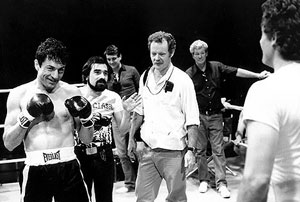
Set of 'Raging Bull'
With his next film, "New York, New York" (1977), Scorsese tried to create a nostalgic look at the movie musical, but shifted gears during filming to shape the story around the deteriorating relationship between a jazz saxophonist (De Niro) and a big band singer (Liza Minnelli). The result was an uneven film and audience fond of music foud te movie depressing. Realizing he was no Busby Berkeley, Scorsese returned to documentary filmmaking with "The Last Waltz" (1978). During the time he was making this film,  Scorsese was living with Band drummer and lead singer Robbie Robertson. Scorsese was doing heavy amounts of drugs, which led to complete exhaustion and a stay in the hospital in the late 1970s and which caused the movie delay for two more years.  Thankfully for De Niro and moviegoers around the world, the director kicked drugs, got back on track, and went on to direct what many considered his masterpiece, "Raging Bull" (1980), which was later regarded as one of the top movies ever made. Scorsese was passed over at the Academy Awards for Best Director and Best Picture, despite De Niro winning a much deserved Oscar for Best Actor.

Scorsese has been married five times. His first wife was Laraine Marie Brennan; they have a daughter, Catherine. He married the writer Julia Cameron in 1976; they have a daughter, Domenica Cameron-Scorsese, who is an actress and appeared in The Age of Innocence, but the marriage lasted only a year. The divorce was acrimonious and served as the basis of Cameron's first feature, the dark comedy, God's Will, which also starred their daughter, Domenica.


Though Scorsese made several films throughout the 1980s they were not that well received as were "Mean Streets," "Taxi Driver" and "Raging Bull." until "GoodFellas" (1990), his long-awaited and welcome reunion with Robert De Niro.Although he stepped back a notch with the ‘the age of innocence’ and Cape fear but got back on track with "Casino" (1995), his eighth collaboration with De Niro. Featuring swirling camera movements, a pumping soundtrack and confiding voiceover from De Niro, "Casino" was a flawed allegory of America's loss of innocence - ground most reviewers felt was covered to better effect in "GoodFellas." With "Kundun" (1997), Scorsese once again got derailed with the set of conventions he followed, focusing more on Dalai Lama.

Scorsese next directed Nicolas Cage as a fast-living EMT in the morbid, psychotropic drama "Bringing Out the Dead" (1999), which ended up one of Scorsese's weakest films. Meanwhile, Scorsese spent a few years working on the epic "The Gangs of New York" (2002), a sweeping look at the New York immigrant riots of the late 19th century. Upon its release, "Gangs" was hailed as a mighty achievement. Scorsese took home a Golden Globe, but earned his fourth Academy Award nod without a win for Best Director.
Deying the hype surrounding the difficulties of bringing "Gangs" to the screen, Scorsese reunited with DiCaprio for "The Aviator" (2004), "The Aviator" won the Golden Globe award for Best Motion Picture. It also led the pack with 11 Academy Award nominations, including Best Picture and Best Director, Scorsese's fifth nod in the directing category.
In 2006, Scorsese made a triumphant return to form with his next film, "The Departed, and was hailed by fans and critics alike; he had studiously avoided the genre since "Casino" in order to explore other avenues.

Meanwhile, "The Departed" earned huge helpings of critical kudos prior to its early October 2006 release, positioning the film for a strong opening weekend. The film did have a substantial box office take - over $120 million all told - while earning the director another win at the Golden Globe Awards for Best Director, setting the stage for an Oscar nomination for Best Director at the 79th Annual Academy Awards. Scorsese finally won the coveted Oscar for Best Director, an honor made that much sweeter when he received a standing ovation and was handed the award by his longtime friends and peers, Francis Ford Coppola, Steven Spielberg and George Lucas. Meanwhile, in 2007, he formed the World Cinema Foundation, a not-for-profit organization dedicated to preserving neglected films for posterity and restoring others that had been damaged by the ravages of time and poor storage.
Back in feature films, Scorsese joined forces a fourth time with DiCaprio for "Shutter Island" (2009) For which Scorsese received the Cecil B. DeMille Award at the 67th Annual Golden Globes, presented to him by both De Niro and DiCaprio. Sorcese directed the pilot episode, of ‘the boardwalk empire’ which earned him an Emmy Award for Outstanding Directing for a Drama Series in 2011. At the end of the year, Scorsese released his next feature, "Hugo" (2011), an inventive children's adventure about a 12-year-old boy. The film was hailed by critics and instantly garnered awards-season buzz.

Tuesday, 17 January 2012

Prowler (Story)

Our movie is about a girl Claire from high class elite family who routinely goes to the parties and nightclubs but gets caught in a situation, of which she stays oblivion and which ultimately threats her life.

The story starts with Claire arriving in the pub with the music blaring from the radio in her car. The music is interrupted with the alert of a smuggler on the loose selling a highly addictive drug and warning everyone be safe and to avoid drinks from the stranger. She flippantly closes the radio and head towards the club. There while waiting for her friends, a man named Ben approaches her. She finds him attractive so she converses with him. He insists on buying her a drink and persuades her to dance with him but without her looking, he slips a white powder in her drink to make her unconscious but before he could drag her someplace, he finds a bulky man in the corner looking for someone. He panics and leaves before slipping a brown package in Claire's bag and deserts Claire while she passes out on the counter

Next morning Claire wakes up at her friend Alison's house but has no recollection of the night. She ultimately presumes she must have had too much of drink dismisses the thought.

For the next few days, she feels as if someone is stalking her. She finds a figure in a hooded jacket following her everywhere and ultimately becomes paranoid which makes her friends gossiping about her.

One day when she stays home alone, she hears noise from her basement. When she goes down to check, Ben grabs her from behind and tries to tell her he will not harm her and is here to protect her. He confirms her suspicion that someone indeed was stalking her because she had what the stalker wanted. He informs her that she was given a date rape drug that night and someone slipped something in her blue purse she carried that night which he wants and because of which her life can be in grave danger. He tells her that someone knows about her address and until that package is delivered to its rightful owner, she is not safe. Not trusting Ben because she could tell he was hiding something, she rushes to her room and retrieves the package before he can and finds that illegal drug she heard about in radio. Clutching the package to herself, she demands that he take her to the safety, they both try and fight this unknown stalker after they get locked down in a dark house. At the end, the drug dealer is killed with the knife and authorities reach the scene. She hands over the package before passing out as the movie ends

Monday, 16 January 2012

Plot


 The story starts with a girl arriving in the pub. The radio talks about a new drug byproduct of ecstasy which is been smuggled in town, before she changes the station to a music channel. After reaching the pub, she walks in and orders a drink. We know from her attire that she belongs from an elite family. With her handing cash to the counter we can tell that she is also spoilt. The exposition is however unclear.

Conflict: A man B walks up to her and talks her into dancing with her. She accepts without showing much reluctance. While she bends down to retrieve her purse, he slips a white powder in her drink which quickly dissolves. He urges her into drinking before they dance but while looking around, he finds a silhouette of a man barging into the pub. Looking tense, he tells her to wait for him. By that time, the girl finished her drink and appeared slightly woozy. He quietly slips a grey packet in her purse and darts away. The girl soon passes out on the bar.

Rising action: The girl wakes up at her friend C’s house with a hangover. Her friend mentions that she happened to be in that same pub. She expresses that it was her first time when she passed out when her friend tells her how stoned she was and asks her what happened. She than shrugs and says ‘must have been the booze’

The protagonist walking home from her school when she feels that someone is following her. We don’t see the man’s face, as he is wearing a black hoodie. When she turns in an obscure lane that stalker also turns. Ignoring she walks home and the man walks past her home.

The protagonist is in a café with her friend C who returns her the purse she at C’s house. Everyone greets or nods at her. Audience now knows she is also the most popular girl in school. It is day time and she feels that same man staring at her through glass wall. Tensed she immediately leaves with her friend and that man turns into her direction. She quickly drags her friend into the car and drive away as fast as they can.

Her friends talk about her obvious paranoia in girl’s washroom with others and she overhears. Furious she claims that she honestly thinks someone was stalking her. Her friend reminds her that she passed out at the pub the other day and it is messing with her mind. Angrily she heads home and she feels a car with black shades following her. Panicked, she runs home and stays locked in her room.

Around evening she talks to her parents about someone stalking her. Her parents ignore ger and tell her that she may be working too hard in her school and she should take it easy, and than get back to what they were doing. A sad expression is shown on the character indicating that she had been a neglected child.

Climax: Another scene is shown when she stay home alone. She hears a voice in the basement. She grabs a knife and walks in the basement. Lights suddenly go off and someone grabs her from behind. She drops the knife. Making sure no one hears them, he tells her to relax and that he wont hurt her. He tries to remind her that he met her at the pub and she was actually drugged by someone. He does not mention’s that he drugged her. She still cannot recall. He asks her about her black purse she carried that night. When they go upstairs and find that package, she hastily opens it to find some transparent liquid filled capsules. She immediately realizes that these are the drugs she heard about in the news that day in pub. She insists that they had it over to the police but the guy profusely refuses and tries to take the package from her. Lights go out. B realizes that the power cut off was deliberately done by someone. The phone lines even don’t work. He tells her to give him the package and lock herself up. Realizing that won’t do her any goods she keeps it to herself and tells him to take her to someplace safe first. Eventually they split up after much hiding to take the intruder down but in the process B is killed. A finds dead B and tries to call the authorities but before she could elaborate on her whereabouts the intruder hears her.

After much chasing, A kills the intruder with the knife found in the basement. With dead B’s phone, the call had been traced and the authorities find A outside with a bloodied knife. She hands them the weapon and the package before passing out.


Sunday, 1 January 2012

Synopsis of our movie

Before making a trailer we had to finalize the story and the synopsis of the movie.
This is the first rough idea we came up with. Improvements and changes are yet to be done.

Our movie will be about a naive girl named A who for the first time goes into a teenage midnight party in a pub where she is drugged by a man named B she meets. B mixes date rape drug into her drink to get her unconscious and then rape her,  but before he could drag her somewhere, things get out of control as another person mysteriously appears. B, on seeing that hooded figure, slips a packet quietly into A's handbag and meets that person. The hooded man aggressively demands for that packet which B denies on having and soon that argument turns into a bar fight. Before B could return to A, she had disappeared. Next morning she wakes up at her friends house having no memory of that party in the pub whatsoever.

As the days pass by, she senses that someone is following her all the time. She is convinced when an attempt is made on her life. At first she reports and demands for the security, but does not sound convincing to her families or to the authorities.

As the story progresses, we find out that two people are stalking her. When the movie is approaching its climax, she finds that person B in her basement who then tries to remind her that he was the one who drugged her and gave her a packet that is in her possession and people out there want to kill her as they thought that she has seen that packet and is now a threat for them. He had stolen the packet from a drug dealer to blackmail him for the money but the situation got out of control and that day in the pub, B was actually trying to hide. They both look into the packet and realize that only way out they have is to turn to police for protection, but before they could place any call, they are ambushed in A's house where electricity goes out and they get locked inside the house. somehow A triggers the security alarm and in the end, everyone dies except for A who, bleeding profusely and limping, hands the package to the authorities before passing out.